


slither.io
Lowtech Studios
I keep coming back to slither.io because it turns a very simple idea into a surprisingly tense action game. You guide a small snake-like creature around a shared arena, collect glowing pieces, grow longer, and try to outlast other players. The controls are easy to understand within seconds, but surviving long enough to become a serious threat takes patience, positioning, and a willingness to retreat when another player has the advantage.
That contrast is the reason I think it still works so well. It is free to play, quick to start, and suitable for Everyone, yet a careless turn can end a run immediately. I can open it when I have only a few minutes, or stay with it longer when I want to chase a better personal performance. The game comes from Lowtech Studios and sits firmly in the action category, although its relaxed presentation makes it approachable for people who do not usually choose fast multiplayer games.
How the game feels today
The central loop is wonderfully direct. I move continuously, steer toward bright food, and watch for opportunities to make another player collide with my body. When that happens, the defeated player leaves behind a valuable trail, creating a tempting reward for whoever can reach it safely. This makes every encounter a decision rather than a simple attack: I may gain a lot by taking a risk, but I can also lose everything by entering a crowded area too quickly.
Movement is the first skill to learn. At the beginning of a run, I usually stay near open space and collect smaller pieces instead of hunting immediately. A long body is useful, but it also makes careless steering more dangerous. When I become larger, I focus less on chasing individual targets and more on shaping the space around me. Cutting across another player’s path, circling carefully, or forcing an opponent toward my body can be more effective than following them directly.
The touchscreen controls are simple enough for casual play, but they reward small adjustments. Large, sudden movements often create problems because the body continues to occupy the route I just took. I get better results by thinking one or two turns ahead and leaving myself an escape route. This is one of the game’s less obvious lessons: collecting food matters, but controlling where I can safely move matters more.
Related News

Why WhatsApp Messenger Still Makes Everyday Communication Feel Easy

Jurassic World: The Game Is the Better Dino Tycoon for Strategic Players

Threads in Real Life: Who Should Join, Lurk, or Leave

How SHEIN Turned Shopping Into an Endless Content Feed

How to Make Fortnite Feel Smarter on Mobile

Should You Switch to Microsoft Outlook on Mobile?
There is also a useful rhythm to a successful run. I begin cautiously, use the outer areas to build confidence, and move toward busier sections only when I have enough length to defend myself. After a large player disappears, the screen can become crowded with rewards. Instead of rushing straight into the pile, I approach from the side and keep turning room available. That small habit has saved more runs for me than aggressive play ever did.
Why short sessions work so well
A typical session does not require preparation, a complicated tutorial, or a long commitment. I can play during a short break, after finishing a task, or while waiting for an appointment. The quick restart after a collision is particularly convenient because failure never forces me into a lengthy recovery process. I simply decide whether the last run ended because of bad luck, impatience, or a mistake I can correct.
That structure also makes the game easy to share with friends. There is no need to explain a complicated objective. The basic challenge is immediately clear: grow, survive, and become difficult to surround. People who enjoy watching a run can understand what is happening even if they have never played before, which gives the game a social quality without requiring a deep rules explanation.
Gallery
Still, the simplicity can become repetitive. The same collection-and-survival cycle is the entire foundation, so players looking for a campaign, character progression, varied missions, or a story will probably feel that something is missing. I enjoy the clean focus, but I would not recommend it as a complete replacement for a larger action game.
Playing around other people
The appeal comes from sharing the arena with players from around the world. Other snakes are not predictable computer targets following a fixed pattern; they create changing traffic, sudden threats, and unexpected openings. A player who looks harmless may turn sharply across my route, while a much larger opponent may make a mistake and give me the chance to grow quickly.
This creates a nice balance between planning and improvisation. I can choose a broad route and aim for a particular area, but I still need to react to what everyone else is doing. The best moments often happen when two large players compete for space and I stay just far enough away to benefit from the result. The worst moments happen when I become so focused on a reward that I forget another body is approaching from the edge of the screen.
One practical tip is to avoid treating every nearby player as an enemy that must be eliminated. Sometimes the safer move is to let a rival pass and continue collecting elsewhere. Chasing someone can pull me into a tight spiral, where a third player has an easy opportunity to cut me off. Patience is not passive here; it is a way to preserve the length I have already earned.
The shared environment also means that the experience can feel uneven from run to run. One game may offer plenty of safe space and gradual growth, while another becomes chaotic almost immediately. I see that variation as part of the attraction, but it can frustrate anyone who wants a carefully controlled competitive match with predictable conditions.
What has changed and what that means for players
The game was released on March 25, 2016, and its continued presence is easy to understand. It has reached over 500 million installs, with an average rating of 3.9 from around 6.6 million ratings. Those figures suggest a game that has remained widely recognizable even though its design is intentionally modest. It is not trying to overwhelm players with systems; its longevity comes from making the basic contest immediately readable.
For someone installing it now, the important point is that the core experience is still about quick competitive survival rather than a large evolution into a different genre. I would not approach it expecting a traditional progression system or a narrative journey. The appeal is the repeatable match structure: start small, make decisions under pressure, and try to improve the next run.
The Android requirements are also fairly accessible. The game supports devices running Android 5.0 or later, which makes it a practical option for people using older phones that cannot comfortably handle newer, more demanding action titles. That does not guarantee identical performance on every device, but the lightweight concept is a clear advantage when I want something that starts quickly and does not feel built only for recent hardware.
Existing users will notice that the game’s identity depends more on refinement of the moment-to-moment contest than on adding layers of complexity. That is good news if you like the original formula and want to return without relearning a completely different game. It is less exciting if you stopped playing because you wanted fresh objectives, deeper customization, or a stronger sense of long-term advancement.
One trade-off deserves attention: the game is free, but in-app purchases are listed at $3.99 per item. I would treat those purchases as optional rather than part of the basic reason to install it. The free entry point is a major strength, especially for casual players, while anyone who dislikes seeing purchase options in a game may find the model distracting. I would first play several sessions without spending anything and decide whether the core loop alone holds my interest.
Small decisions that improve a run
My most useful adjustment has been to separate growth into phases. Early on, I collect safely and avoid dramatic confrontations. In the middle of a run, I start using my length to close angles and protect valuable areas. Later, I stop thinking about becoming bigger at all costs and focus on keeping enough open space to turn. This prevents the common mistake of growing successfully and then throwing away the run through one greedy move.
Another helpful technique is to watch the direction of movement rather than only the size of a rival. A large player is intimidating, but a smaller one moving unpredictably can be just as dangerous. I pay attention to where a player is likely to turn and avoid crossing their projected path. When I need to pass near someone, I leave more room than seems necessary because the screen can become crowded very quickly.
I also recommend using the edges thoughtfully. They can feel safer because fewer players may be nearby, making them useful for early growth. However, the edge limits escape options. If another player approaches from the inside, I can become trapped between that body and the boundary. I use the perimeter as a temporary route, not as a permanent hiding place.
When a large amount of food appears after a collision, I do not automatically assume it belongs to whoever arrives first. The area is often a danger zone. I circle around the outside, identify the safest entrance, and leave as soon as another player begins to contest the space. Taking half the reward and surviving is usually better than grabbing everything and losing a long run.
Where it fits among other action games
Compared with a conventional arcade action game, this one has fewer moving parts and less structured variety. There are no elaborate stages for me to master in sequence, and the challenge comes from other players rather than a designed chain of enemies. That makes it easier to pick up, but it also means the game cannot provide the same sense of authored discovery as a level-based alternative.
Compared with more complex online multiplayer games, it is much less demanding. I do not need to learn a large roster, memorize abilities, or spend time preparing a loadout. The advantage is convenience: I can understand a match almost immediately. The disadvantage is that experienced players may eventually want more strategic tools than steering, timing, and spatial control.
It is also different from offline snake-style games because the main tension comes from unpredictable human behavior. A computer opponent can be challenging, but it usually follows patterns that become familiar. Here, the same situation can unfold differently depending on how nearby players react. If online competition is the part that interests you, this is a strong reason to choose it; if you prefer calm practice without outside interference, a traditional offline alternative may suit you better.
I would recommend it most to people who enjoy quick restarts, simple controls, and competition that rewards caution. It is especially good for players who like improving through observation rather than unlocking equipment. I would suggest skipping it if you need a story, a clear campaign ending, extensive personalization, or a reliable sense of progress between sessions.
Friction points worth knowing before installing
The biggest limitation is repetition. The basic objective remains familiar after the novelty fades, and not every run feels meaningfully different. I can create variety through my own approach—safe collection, aggressive hunting, or careful ambushing—but the game itself does not transform those approaches into separate modes of play.
The competitive setting can also punish mistakes harshly. A run that took time to build can end because of one turn made too close to another player. I enjoy that risk when I am focused, but it can feel unfair when the screen becomes crowded or when I am playing casually. The right mindset is to value each run as a short experiment rather than treating every collision as a major loss.
Because the game is designed for quick action, it is not the best choice when I want a relaxing experience with no pressure. Even a quiet start can become tense once larger bodies begin competing for space. On the other hand, that pressure is exactly what makes a successful escape or well-timed interception satisfying.
The age rating of Everyone makes it broadly approachable, and the basic concept is easy for younger players to understand. Adults should still consider whether competitive online play and optional purchases fit the player using the device. I would explain the purchase model before handing over a phone, particularly because the game is free to start and the temptation to buy can appear after repeated sessions.
Who should try it and what to watch next
If I were recommending one free action game for a friend who wants something immediate, I would mention this one with a clear qualification: enjoy it as a compact skill game, not as an all-purpose entertainment platform. Its strongest qualities are the instant objective, the readable controls, and the way every opponent changes the shape of the arena. Those qualities remain valuable even after many years.
Before installing, I would ask myself three questions. Do I enjoy repeating short runs to improve? Am I comfortable losing progress because of one bad decision? Do I want human unpredictability more than a structured campaign? If the answer to those questions is yes, the game is likely to fit. If I want unlocks, storytelling, or a calmer pace, I would choose a different action title instead.
For new players, my practical routine is simple: spend the first few runs learning steering, stay away from crowded centers, and resist chasing every opponent. Once movement feels natural, begin testing controlled cuts across another player’s route. Keep an escape direction in mind before entering a busy area, and leave a reward pile when it becomes contested. These habits make the game feel less random without removing its uncertainty.
What I would watch over time is whether the experience continues to benefit from its focused design or begins to feel too narrow for returning players. Its established audience and broad reach show that the formula has staying power, but longevity also raises expectations. Players who already enjoy the current loop may prefer careful preservation, while lapsed players may need meaningful reasons to return.
My final impression is positive, with realistic limits. slither.io is at its best when I want a free, fast action game built around positioning and nerve. It gives me enough depth to reward better decisions without burying the basic idea under menus or complicated systems. I would not call it endlessly varied, and I would not choose it for a story-driven evening, but for a quick competitive session where one clever turn can change everything, it remains an easy game to recommend.
FAQs for slither.io
What is slither.io and how does it work?
Slither.io is a popular multiplayer online game where players control a snake-like avatar. The objective is to consume pellets to grow longer while avoiding collisions with other players' snakes. The game ends if you crash into another snake, making strategic movement and planning essential for survival and high scores.
Is slither.io free to play, and are there in-app purchases?
Yes, slither.io is free to download and play on both Android and iOS devices. While the core gameplay is available without cost, the app offers optional in-app purchases. These purchases typically include cosmetic enhancements, such as skins or patterns for your snake, which do not affect gameplay.
Can I play slither.io offline or is an internet connection required?
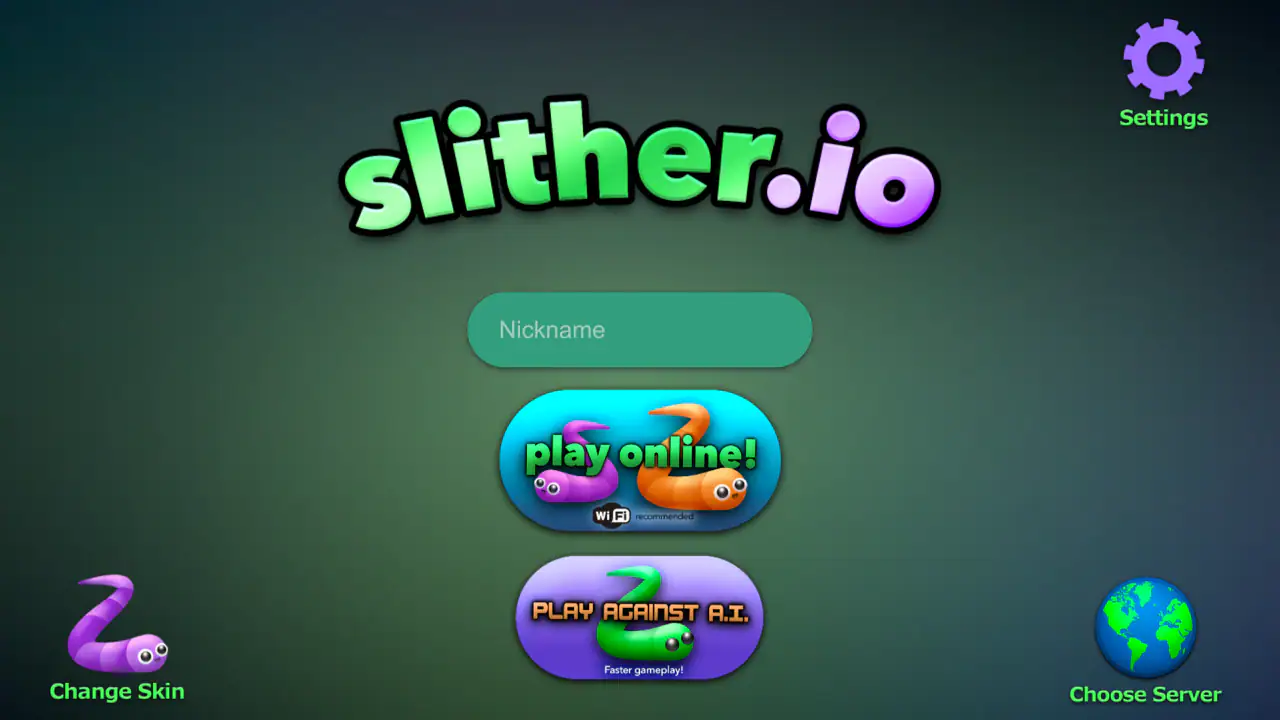
Slither.io requires an internet connection to play, as it is primarily a multiplayer game. However, there is an option to play against AI-controlled snakes instead of human players. This mode can be played offline, offering a similar experience without the need for connectivity.
How does slither.io ensure fair gameplay and prevent cheating?
Slither.io employs several measures to maintain fair play and prevent cheating. These include server-side checks to detect unusual behaviors and regular updates to patch exploits. As with any online game, maintaining a fair playing environment is a continual process, and developers actively monitor and address concerns.
What are the system requirements for slither.io on mobile devices?
Slither.io is designed to be lightweight and accessible, running smoothly on most modern Android and iOS devices. It requires a minimum of Android 2.3 or iOS 8.0. However, for the best experience, using a device with updated software and decent hardware specs is recommended to ensure smooth gameplay.
Pros
- Simple and addictive gameplay loop.
- Free to play with no time limits.
- Smooth and responsive controls.
- Multiplayer mode offers real-time competition.
- Bright
- colorful graphics enhance experience.
Cons
- Can experience occasional lag issues.
- Ads can be intrusive during gameplay.
- No offline mode available.
- Limited customization options.
- Repetitive gameplay may bore some users.


